


Two things are true about Singapore property in September 2026, and they shouldn't both be true at once. HDB is launching 19,600 BTO flats this year, the most in a generation. The 15-month wait-out period that penalised private owners for downsizing into HDB resale was scrapped in July. En-bloc consent thresholds are being cut so ageing developments can redevelop more easily. Every lever the government has for easing pressure on housing got pulled in 2026.
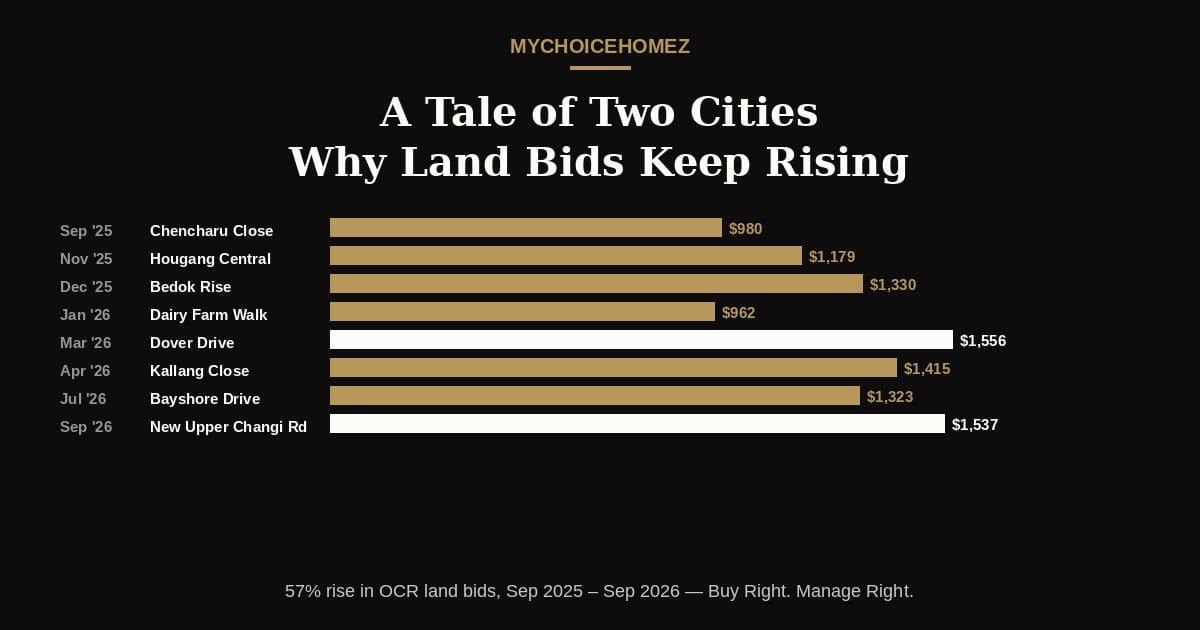
And OCR land bids went from $980 psf ppr in September 2025 to $1,537 psf ppr in September 2026, a 57% climb in exactly twelve months, with two new regional price records set on the way.
What the Relief Side Actually Fixed
HDB launched about 19,600 BTO flats in 2026 across three exercises, more than 4,000 of them with waits under three years, and 127 projects are now under construction against 110 a year earlier (HDB, 2026). On 28 July 2026, the government scrapped the 15-month wait-out that made private owners sit out for over a year before buying an HDB resale flat, in direct response to HDB resale prices softening in the first half of the year (HDB/MND, July 2026). And a Bill before Parliament would cut en bloc consent thresholds from 80% to as low as 65% for developments over 60 years old.
Every one of these moves genuinely reduces friction somewhere in the system. None of them adds a single unit to the private developer land pipeline.
Sources: URA tender records, 99.co, EdgeProp, The Edge Singapore and CBRE Singapore commentary, September 2025 to September 2026.
Why the Bids Kept Climbing Anyway
Move 2: What The Market Isn't Telling You Four Forces the Headlines Skip+ Read → − Collapse
New private home sales fell 65.1% month on month in June 2026 because of what ERA Research called an "absence of fresh stock". Developers are running low on launch-ready homes, and low stock is exactly what makes them bid hard for the next site (ERA Research, June 2026).
En bloc supply is shrinking to boutique deals. The 35% developer ABSD and the five-year deadline to sell every unit punish big collective sales, so 2026's en bloc activity has centred on smaller freehold sites, and a lower consent threshold doesn't change that maths (PropertyNet.SG, 2026).
Land bids are a leading indicator, not a live one. A developer bidding today is pricing the market as it expects it to be at launch, 18 to 24 months away, not this half's GLS Confirmed List. The 2H2026 Confirmed List is more than 50% above the ten-year average, and land prices still climbed, because bidders are looking past this year's number.
And most big developers already have land through 2027, thanks to a heavy 2H2026 GLS pipeline (Bayshore Drive, Holland Plain, Peck Hay Road, River Valley Green C). Being well stocked doesn't make developers passive. It lets them be choosy, and choosy bidding on sites they see as truly scarce is what produces record prices on individual tenders even when overall land supply looks plentiful on paper.
The Seven-Part Answer
There's no single "right move" here. The honest answer depends on which side you're standing on. This series splits it into seven pieces, each answering one question directly: how the two markets differ, what the land bid data says corridor by corridor, why the en bloc changes won't flood anything, what the end of the wait-out means for downgraders, what it means for timing if you're buying, what rising land costs do to landlord yields, and why rents aren't following sale prices. Read the one that fits you, or all seven; they link to each other throughout.
Frequently Asked Questions
Is Singapore private property about to get cheaper because of more BTO supply?+−
Why did the government remove the 15-month wait-out period?+−
Will lower en-bloc consent thresholds flood the market with new sites?+−
How much have land bids actually risen?+−
Who should read this series?+−
Your situation is different. Get it in writing.
I'll work through your budget, loan, options and exit in a free written Property Decision Review. No obligation.
Get my free Property Decision Review →Sources + Show all 7 →
2. HDB/MND, 15-month wait-out period removal announcement, 28 Jul 2026 (reported by The Edge Singapore, ERA, StackedHomes)
3. AsiaOne / 99.co, Land Titles (Strata) (Amendment) Bill 2026 coverage, Aug 2026
4. ERA Research, “June 2026 Developer Sales,” Jun 2026
5. PropertyNet.SG, “Why Singapore's En Bloc Market Is Going Boutique in 2026,” 2026
6. CBRE Singapore, GLS land rate commentary, 2025 to 2026
7. URA tender records; 99.co, EdgeProp, The Edge Singapore GLS coverage, Sep 2025 to Sep 2026
This article is for informational and educational purposes only. It does not constitute financial, investment, or legal advice. Property investments involve risk. Past performance is not indicative of future results. Readers should seek independent advice from licensed professionals before making any property or financial decision. James Ong is a licensed real estate salesperson (CEA Reg No. R008385F) with PropNex Realty Pte Ltd and is not a licensed financial adviser.
James Ong | CEA Reg No. R008385F | PropNex Realty Pte Ltd

Member discussion