
↑ Back to the full review · Part 1 · Part 2 · Part 3 · Part 5 · Part 6 · Part 7
Hougang Central Residences: The Yield Reality: What This Corridor Actually Rents For, Not What the Brochure Projects
Every developer presentation shows a projected yield, based on what the developer thinks rents will be when the project completes, which is 2030 or later. The honest number is what the Hougang and Kovan rental market pays today, and whether a unit bought at $3,126 psf earns enough to justify holding it. For investors, the answer is uncomfortable.
At current D19 rental rates of approximately $3.50 to $4.50 psf/month, a 600-sqft 2BR at Hougang Central (purchase price ~$1.88M) yields approximately 2.7 to 3.4% gross. A 900-sqft 3BR (~$2.81M) yields approximately 2.5 to 3.0% gross. After mixed-development maintenance fees, net yield will be below 2.5% for most unit types. This is a capital appreciation play, not a yield play.
Move 1: What D19 Actually Rents For
The Hougang and Kovan rental market has a steady base of tenants: NEL commuters, upgrader families and professionals working in the northeast or city fringe who like the price gap against RCR districts. Demand is real and consistent. It isn't a speculative rental market.
Current D19 rental transactions (SRX, 2025 data) for leasehold condominiums in Hougang and Kovan show broadly the following ranges:
| Unit Type | Approx. Monthly Rent | Psf/month | Note |
|---|---|---|---|
| 1BR / ~450 to 500 sqft | $2,300 to $2,800 | ~$5.00 to $5.60 | Tight supply, strong demand |
| 2BR / ~600 to 700 sqft | $2,800 to $3,500 | ~$4.00 to $5.00 | Most liquid unit type for rental |
| 3BR / ~900 to 1,000 sqft | $3,500 to $4,500 | ~$3.50 to $4.50 | Family tenants, slower turnover |
| 4BR / 1,300+ sqft | $4,500 to $5,800 | ~$3.20 to $4.00 | Longer vacant periods between tenants |
Sources: SRX D19 rental transaction data, 2025. Figures are approximate market ranges; actual rents vary by floor, stack, view and condition.
At these rental rates, a 2BR at Hougang Central (600 sqft, estimated purchase price ~$1.88M) renting for $2,800 to $3,500/month produces a gross yield of approximately 1.8 to 2.2% at the lower range and 2.2 to 2.7% at the upper range. Even at the top of the D19 rental range for a 2BR, gross yield barely clears 3%.
Move 2: The Mixed Development Yield Equation
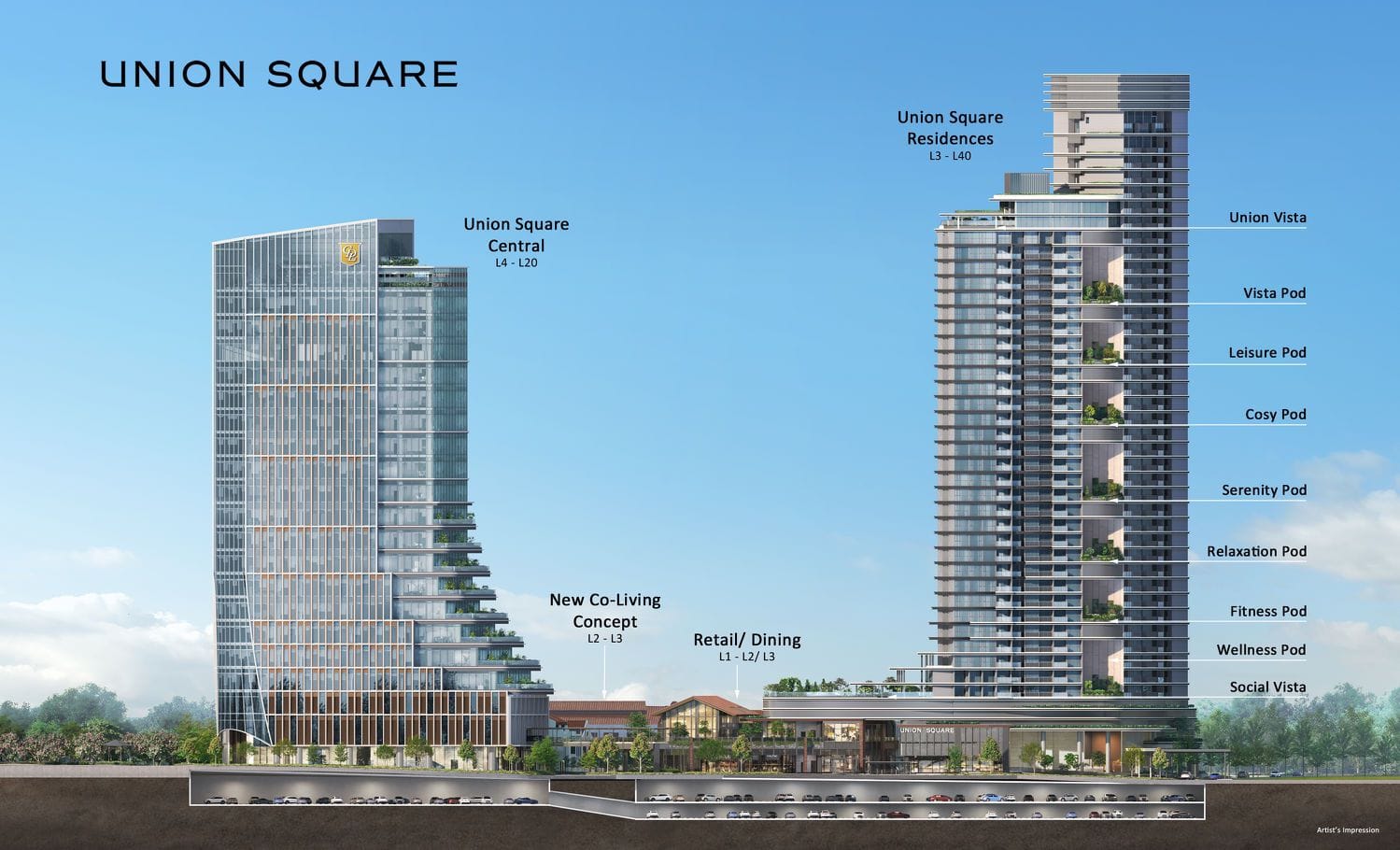
Yield in a commercial-residential development carries a built-in cost drag that standalone condos don't. The maintenance fee has to cover both the residential tower and the podium's running costs. Going by comparable mixed developments in Singapore, such as Sengkang Grand Residences, Duo Residences and Midtown Modern, residential maintenance fees run about 20% to 35% higher per sqft than in comparable standalone condos, reflecting shared costs like commercial amenities, escalators, the podium facade and the managing agent's wider brief.
For a 900 sqft 3BR, a mixed-development maintenance fee at the upper end of that range might be $600 to $800 a month, against $400 to $500 for a comparable standalone OCR condo. That $150 to $300 difference comes straight off your net yield. At $3,126 psf, every extra $150 a month cuts net yield by about 0.06%.
The retail podium does lift rental demand. Tenants choose mixed developments for the convenience on site, which can support rents about 5% to 10% above comparable standalone condos in the same corridor. That partly offsets the higher maintenance fee, but not fully at today's D19 rents.
James has managed buildings with commercial-residential strata structures. What surprises residential owners most isn't the level of the maintenance fee. It's how it moves. A well-run MCST reviews its sinking fund contributions every three to five years, and in a mixed development the review almost always goes up as the commercial equipment ages. If you're buying for yield, assume the maintenance fee won't stay still. The full governance story is in The Management Reality.
Move 3: The Honest Yield Verdict
Hougang Central Residences isn't a yield investment at about $3,126 psf. That's not a criticism of the project. It's the market reality. OCR launches built at post-2025 costs produce yields that will cover little more than costs, or less, in most scenarios for the first five years. Rents don't rise fast enough to close the gap quickly.
The investment case for Hougang Central rests on capital appreciation over a 10-year horizon, not on annual income. If you are buying as an investor, you need to be comfortable carrying a near-zero or slightly negative net cash flow for several years in exchange for the corridor appreciation thesis. If you need the rental income to service the mortgage, the numbers do not currently support this development at launch ASP.
For owner-occupiers, yield doesn't matter because you're not renting it out. For investors with patient money and a 10-year-plus view of the northeast, the picture improves as rents grow and as CRL-led repricing lifts comparable rents. Speak to a licensed financial adviser about financing and carrying costs before committing. James isn't a financial adviser and doesn't advise on personal financial strategy.
"Hougang Central is the first major development in Hougang, and it's a mixed development."
Yield in a mixed development has a layer most investors miss: the maintenance fee isn't fixed. In a commercial-residential MCST, contributions get reviewed as the retail equipment ages. I've seen maintenance fees in mixed developments rise 25% to 40% over the first 10 years as the commercial plant, escalators, retail air-conditioning and podium waterproofing, starts needing major work. Build that into your yield model, not just today's rate.
James Ong, CEA R008385F | PropNex Realty
Frequently Asked Questions
Will having integrated retail improve rental demand for my unit?
Yes, modestly. Across Singapore's mixed developments, integrated retail tends to command rents 5% to 10% above comparable non-integrated condos in the same corridor. Tenants, especially families and young professionals, value groceries, dining and services on site. The premium is strongest in the first five years after TOP and tends to fade as the surrounding area gets more shops.
What kind of tenants typically rent in the Hougang corridor?
D19 draws a mix of Singapore PRs and citizens who'd rather rent a private condo than an HDB flat, NEL commuters and some expat tenants, though fewer than in CCR or RCR districts. The tenant base is stable, with lower turnover than central districts. Vacancy in well-run D19 condos is generally low, usually under 5% when demand is normal.
How much higher are maintenance fees in a mixed development?
Based on comparable commercial-residential developments in Singapore, maintenance fees in mixed developments run about 20% to 35% higher per sqft than standalone condos of similar quality in the same region. Hougang Central's actual figure will be set at the first AGM, which must be held within 12 months of the first strata titles being issued. Budget conservatively, and ask for the developer's management budget projection before signing.
Is yield likely to improve significantly by the time TOP arrives?
D19 rents have risen in recent years and are likely to keep growing modestly in line with the wider market. CBRE Research (February 2026) expects stable rental growth in 2026. By the time Hougang Central completes (2030 or later), D19 rents may be 10% to 20% above 2025 levels, narrowing but not closing the yield gap at $3,126 psf. That helps, but it doesn't change the yield story.
Read the full Hougang Central Residences series:
The Complete Analysis · The Price Floor · The Floor Plan Trap · The Pricing Test · The Yield Reality · The Spine · The Exit · The Management Reality
Is this project right for you?
Every buyer's numbers are different. I'll check your budget, loan, the alternatives and your exit in a free written Property Decision Review. No obligation.
Get my free Property Decision Review →Sources
- SRX: D19 rental transaction data, 2025 (Hougang, Kovan, Serangoon)
- PropNex Research: Hougang Central ASP estimates; maintenance fee comparables (Jun 2026)
- CBRE Research: Singapore Real Estate Market Outlook 2026 (Feb 2026)
- URA REALIS: D19 rental transaction comparable data
- Sengkang Grand Residences: maintenance fee data from MCST records (public)
- Building Maintenance and Strata Management Act (BMSMA): Section 78, maintenance contribution apportionment
This article is for informational and educational purposes only. It does not constitute financial, investment, or legal advice. Property investments involve risk. Past performance is not indicative of future results. Readers should seek independent advice from licensed professionals before making any property or financial decision. James Ong is a licensed real estate salesperson (CEA Reg No. R008385F) with PropNex Realty Pte Ltd and is not a licensed financial adviser.
James Ong | CEA Reg No. R008385F | PropNex Realty Pte Ltd
WA: 91111173 | wa.me/6591111173



Member discussion